Local food & Restaurant
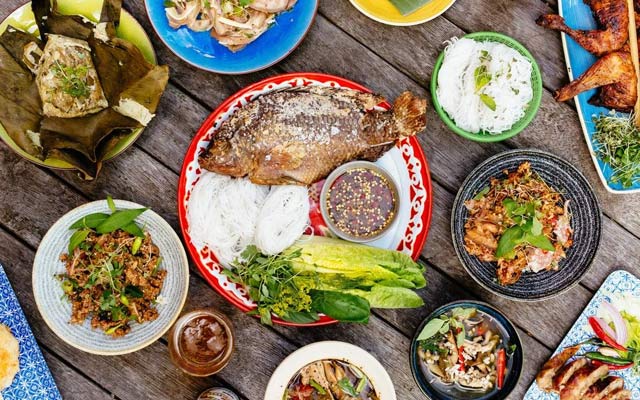
Laos food is distinct from other Asia cuisines, although it is somewhat similar to the food found in the northeastern part of Thailand in the area known as Isan. Most Lao dishes contain vegetables and herbs, rice or noodles and fish, chicken, pork or beef. The freshness of the ingredients is very important to Lao people who like to prepare everything from scratch, rather than use pre-prepared ingredients, as they believe this makes their food more delicious. Herbs such as galangal and lemongrass are favorites and Padaek (Lao fish sauce) is found on every table.
One of the staples of Laos food is sticky rice. As the name reveals, this rice naturally sticks together so it is easy to roll into small balls, dip into food and eat with your fingers. A traditional everyday Lao meal is simple and normally consists of sticky rice, some natural vegetables and at least one kind of spicy sauce to dip the sticky rice into, plus perhaps some fish or meat. Another favorite daily is noodle soup (called feu also spelt pho) which is a hearty soup incorporating meat, noodles and vegetables. Don’t be surprised if when ordering your noodle soup, a huge plate of local salad vegetables arrives at the same time, together with a range of sauces and condiments.


Although Lao cuisine has many influences, such as Thai, Vietnamese, Chinese and French, when talking about Laos food, most people who know Laos or have been to Laos would know laap (sometimes spelt Laab or Larp). Laap is a dish that is particular to Laos and is often served on special occasions such as weddings, Baci ceremonies or other celebrations as in Lao language laap means luck or good fortune. However, you will find it served in every good Lao restaurant around the country.
Laap is made from chopped or thinly sliced meat or fish that is mixed with lime juice, fish sauce, mint, coriander, spring onion, chili and uncooked rice grains that have been dry fried and crushed. It is usually accompanied by vegetables including eggplant, fresh chilies, mustard leaves and lettuce. It can be eaten with ordinary rice or sticky rice and is usually eaten with fish/meat soup depending on the main ingredient being used.
If you are a visitor, it is useful to ask that your laap is cooked, as in some parts of the country locals like to eat it raw, particularly fish laap.
Other Lao favorites include bamboo shoot soup, papaya salad (a spicy mix of green papaya, lime juice, fish sauce, fresh chilies and peanuts), barbecued fresh fish and grilled meats (often served as small kebabs) and steamed fish or chicken in banana leaves.
Laos is blessed with a huge variety of fresh fruit and most meals will conclude with a plate of freshly cut fruits such as mango, pineapple, watermelon and dragon fruit.
You can wash down your Lao meal with the country’s award-winning beer, Beer Lao, or fresh juices made from lime, sugar cane or coconut, as well as fruit shakes.

01. Feu
Feu is a Lao beef noodle soup, believed to be a variation of the Vietnamese dish phở. It is made by pouring a boiling broth over rice noodles, thin slices of beef, and a variety of fresh local herbs and vegetables. This can include onions, garlic, cilantro, galanga, lemongrass, Thai basil, kaffir lime leaves, and mint.
Feu is generally eaten as a breakfast dish but can be easily found at local street stands during the entire day. Some variations of feu are not served with noodles, but as a stew that is meant to be enjoyed with sticky rice, another local favorite.


02. Khao Piak Sen(Noodle Soup)
Khao piak sen is one of the most popular Lao noodle soups in Laos especially in Vientiane where you can find stalls serving both the noodle and rice versions in the morning. The bowl is filled with freshly hand cut rice tapioca noodles and the broth is a fragrant ginger soup and then its garnished with all your favorite condiments and dipped with khanom kuu (Chinese donut). Below is one of my Lao recipes with different noodle texture variations.
03. Papaya salad
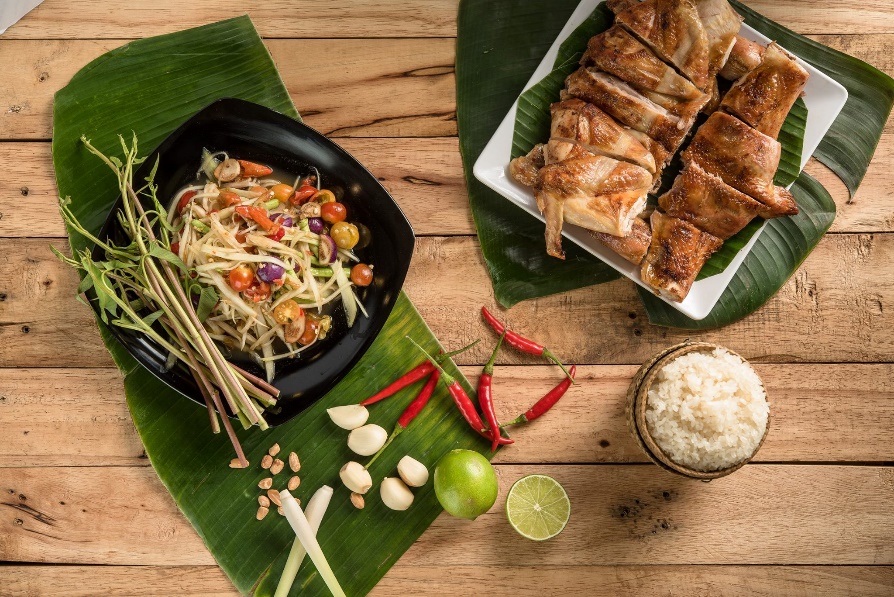
Tum Maak Hoong, aka Papaya Salad is a popular spicy salad in Laotian Cuisine. “Tum” means pounded, as the unripe shredded papaya and other ingredients are pounded in a mortar with a pestle. “Mak Hoong” means papaya. The unripe papaya has a crunchy texture and the combined flavors of spicy, salty, sweet and sourness will have this salad satisfying all your taste buds.
The main ingredients in papaya salad include unripe shredded papaya, chilies, garlic, cherry tomatoes, lime, sugar and fish sauce. Some like to add slices of Thai eggplant and long bean to give it extra crunch.
To make it authentic, Lao people like to use a fermented fish sauce called Padaek. It is a fish sauce condiment that has been cured. It is thicker than fish sauce and often contains pieces of fish. Be warned that the smell of Padaek is very pungent, so try not to spill it! Crab paste and shrimp paste is also used to increase the saltiness flavor.
04. Lab
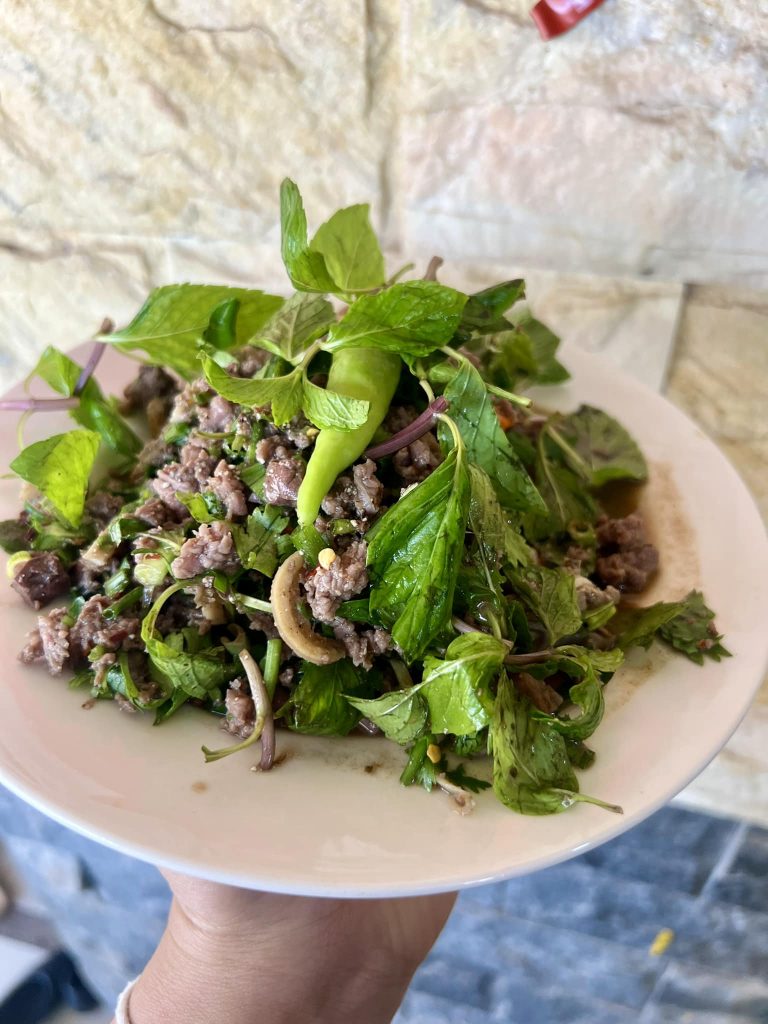
Lap is one of the popular dishes of Lao people. It is made from animal meat such as beef, buffalo, pork, duck, chicken, fish… In addition, there are many decorations that decorate the food to be beautiful and pleasing to eat. Lap is one of the popular dishes of Lao people, made from animal meat such as beef, buffalo, pork, duck, chicken, fish… In addition, there are many decorations that decorate the food to be beautiful and pleasing to eat.
Ingredients: Beef, pork, duck, chicken, fish…. fish sauce, chili, fragrant vegetables, cow’s milk, fried rice, radish
05. Kaipen (River weed)
Kaipen is a Laotian snack made of fresh water green algae, garlic, vegetable, and sesame seeds. Kaipen is produced in northern Laos and is especially popular in the city of Luang Prabang. During the dry winter months (November to April), when the river level is at its lowest, the green algae called kai is gathered from the river bottom. It is washed and pounded thoroughly for maybe a couple of hours, generally in fresh water outside of the river and then set into cubes. A boiled, flavored liquid including water, green and black olives and tamarind is then poured over it. Each cube is flattened on a plastic sheet and then placed on a flat reed mat. There, sesame seeds, and optionally dried sliced garlic, tomato and onion slices are sprinkled over it. The reed mats are then placed outside on a wood framed network to dry/cook in the sun for at least 7 hours. The finished product resembles a large sheet of Japanese nori. The Kaipen sheets are packed into plastic bags for resale.
Kaipen is rich in vitamins and minerals and tastes like nori but is slightly more sweet, bitter, and aromatic. Kai can be eaten by itself or used to flavor other foods. Flash-frying is the preferred method of preparation, after which it can be eaten like a snack

06. Sticky Rice
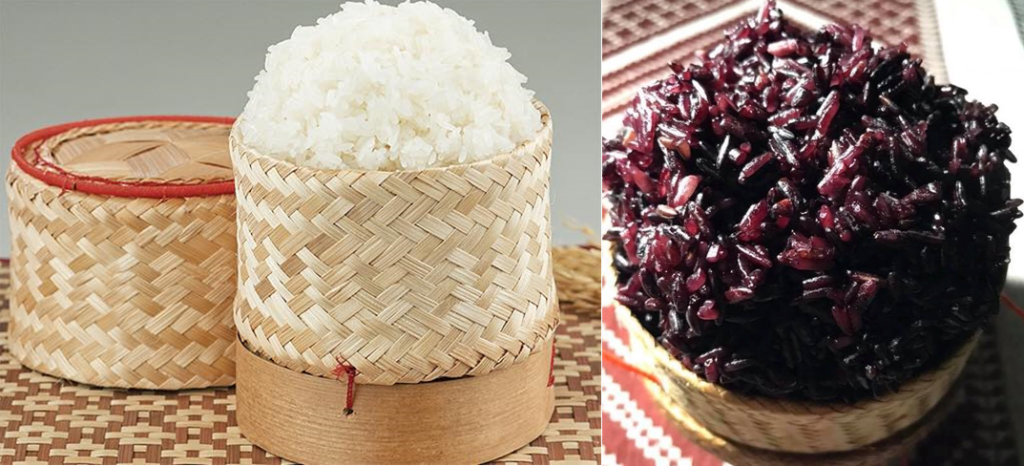
Glutinous rice is a type of rice that is characterized by the sticky adhesion of ripe rice grains. Planted a lot in the Lao People’s Democratic Republic and the northeastern part of the Kingdom of Thailand . Sticky rice is widely enjoyed in Laos and is a staple of the country. In addition to direct consumption, glutinous rice is also used as a raw material for making traditional rice flour , making glutinous rice flour for the food industry and snacks .
Sticky rice has 2 colors, white and black, but black sticky rice will have more nutrients than white sticky rice. Nutrient called OPC (OPC) has properties to help slow down the aging and degeneration of the body.
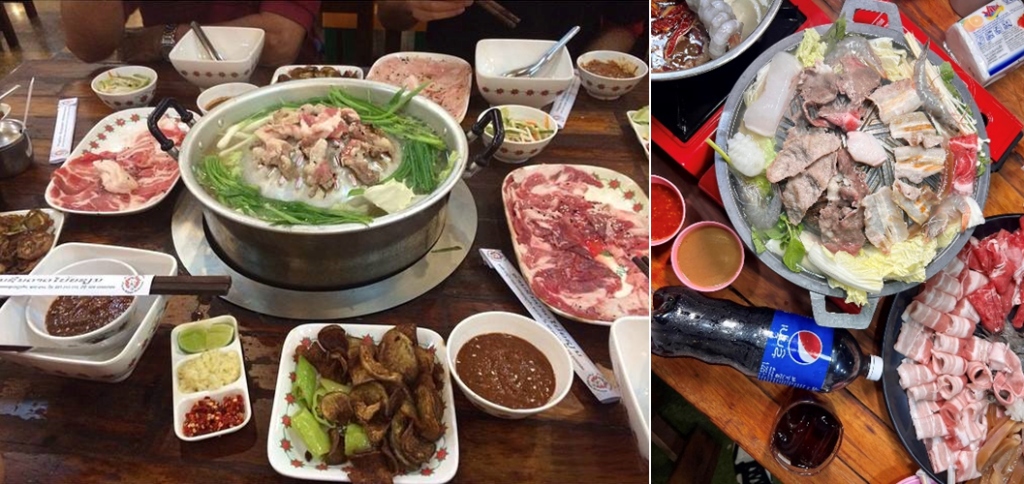
07. BBQ (Sindad in Lao language)
It is very command to see local people having BBQ for dinner in Laos, this BBQ looks like Korea BBQ. There are pork, fish, vegetable and seafood BBQ, you should not miss it